
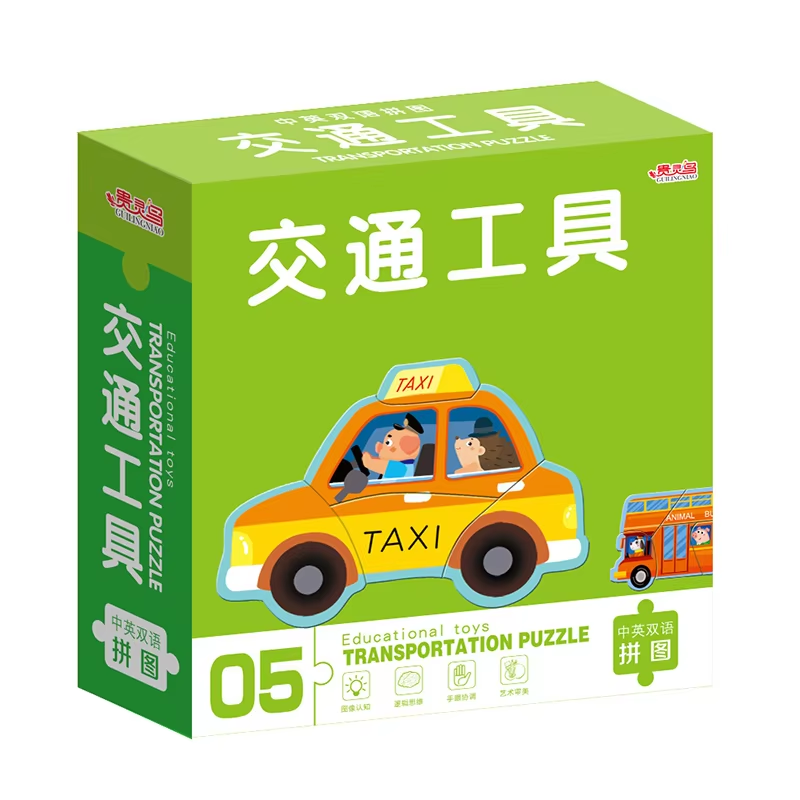
How Puzzle Play Drives Cognitive Development in Children
The science behind cognitive development in children and puzzle engagement
When kids work on puzzles, different parts of their brains get activated at once. The prefrontal cortex handles decisions while the parietal lobe deals with figuring out shapes and spaces. Studies have found something interesting too. Kids who spend time putting together puzzles show about 20-25% more activity in their visual processing areas than when they're just sitting around doing nothing. All this brain exercise helps build those important skills we call executive functions. Things like remembering what needs to be done next and switching between tasks become easier over time. These abilities are basically the building blocks for complex thinking and problem solving later in life.
Linking puzzle toys for cognitive skills to neural pathway formation
Repeated puzzle use promotes neuroplasticity by reinforcing synaptic connections during critical developmental periods. Each successful piece placement triggers dopamine release, creating a reward loop that enhances myelination in pathways linked to logical reasoning. As a result, children who regularly engage with puzzles demonstrate 18% faster problem-solving response times by age 8.
Key developmental milestones enhanced by regular puzzle play
- Ages 2–4: Improves pincer grasp precision through knobbed puzzle pieces
- Ages 5–7: Enhances pattern recognition at a rate equivalent to six months of natural visual learning
-
Ages 8+: Develops geometric visualization skills strongly associated with future STEM aptitude
Consistent puzzle interaction supports the transition from concrete to abstract thinking, with studies showing toddlers proficient in puzzles master shape categorization 40% faster than peers.
Long-term academic benefits of early problem-solving skill development
Kids who spend about three hours or more each week playing with puzzles before starting school tend to do significantly better academically later on. Studies have found they score around 32 percent higher on math readiness tests and their reading comprehension skills are roughly 28% stronger by the time they reach third grade. What makes puzzles so effective? They teach kids how to tackle problems step by step, which carries over into classroom work. Teachers report seeing about 25% fewer cases where these students give up when faced with tough homework or class projects. The persistence developed through puzzle play seems to stick with them as they progress through school.
Top Puzzle Types That Enhance Core Cognitive Skills
Classic Jigsaw Puzzles: Building Spatial Reasoning Through Shape and Pattern Recognition
Jigsaw puzzles train children to interpret spatial relationships and subtle visual gradients. Rotating and fitting pieces develops mental rotation abilities essential for success in STEM fields. According to the Child Development Institute (2023), 56% of children who regularly complete jigsaws demonstrate above-average map reading skills.
Wooden Block Puzzles: Developing Fine Motor Skills and Early Logic in Toddlers
Chunky wooden puzzles with pegs or cutouts provide tactile feedback that sharpens fine motor control and hand-eye coordination. Toddlers learn cause-and-effect logic through trial and error, establishing early foundations for mathematical reasoning.
3D Puzzles: Advancing Geometry Understanding and Task Persistence in Older Children
Putting together those complex 3D structures teaches people about things like cross sections, balance, and how weight gets distributed across different parts. These are actually really useful skills when it comes to engineering work later on. Most folks take around an hour and a half or so to finish a 100 piece model, which definitely helps develop concentration and stick-to-itiveness. A study published in the Journal of Educational Psychology last year found that students who regularly worked on 3D puzzles showed about a third better focus during class time compared to their peers who didn't do this kind of activity as much.
Logic and Brain Teaser Puzzles: Strengthening Analytical Thinking and Memory
Puzzles like Sudoku variants and sequence matrices challenge children to hold multiple variables in working memory while testing hypotheses. This process has been shown to increase prefrontal cortex density by 11% in pre-teens, according to NeuroScience for Kids (2023), enhancing analytical capacity and long-term cognitive efficiency.
Magnetic Puzzles: Fostering Creativity and Bilateral Coordination Through Open-Ended Play
Magnetic tiles and building sets encourage limitless configurations, blending creative design with intuitive physics exploration. Constructing symmetrical or balanced forms naturally engages both hands, promoting bilateral coordination and strengthening interhemispheric neural communication.
Matching Puzzle Complexity to Child Development Stages
Guidelines for selecting age-appropriate puzzles from toddler to pre-teen years
The way kids interact with puzzles changes quite a bit from when they're just one year old all the way until they hit twelve. For little ones aged 1 to 3, big puzzles with around 3 to 8 pieces work best. These should have those nice thick pieces with knobs on them so tiny hands can grab hold easily. This helps babies start recognizing shapes while also working on those important finger movements. When kids get to be 3 to 5 years old, they really enjoy puzzles with about 10 to 24 pieces. Parents often pick ones with animals or cars since these themes are familiar to young children. Playing with these actually helps build their ability to understand how things fit together in space. By the time children reach school age (around 6 to 12), they're capable of handling much harder puzzles. We're talking about jigsaw puzzles with over 50 pieces where colors blend into each other, or even three dimensional models that require some serious thinking. Some parents find that logic games become popular too during this stage because kids start getting better at figuring out problems without seeing the whole picture right away.
Expert-recommended puzzle types for ages 3–12 based on cognitive readiness
- Ages 3–5: Layered puzzles illustrating cause-and-effect sequences (e.g., life cycles or weather patterns)
- Ages 6–8: Interlocking jigsaws with 36–60 pieces requiring edge-sorting and strategy
- Ages 9–12: Multi-component mechanical puzzles like Rubik’s Cube variations or modular engineering kits
Children who engage with puzzles approximately 17% beyond their current ability—the “learning zone”—show 23% faster growth in spatial reasoning compared to those using mismatched difficulty levels.
Balancing challenge and engagement to sustain concentration and motivation
Good puzzle picking works kind of like the Goldilocks story really. The puzzles need to be challenging enough to keep kids interested but not so tough they give up altogether. When puzzles are too simple, children just lose interest pretty quickly. On the flip side, if something's way too difficult, it can actually make them frustrated instead of engaged. We recommend switching up the puzzle styles roughly every four to six weeks to keep things fresh. Maybe throw in some themed puzzles next month, like ones featuring old world maps for learning geography basics. Or try out some special edition puzzles where pieces respond to sounds for extra sensory stimulation. Keep an eye on how long it takes to finish these puzzles as well. For little ones between three and five years old, around eight to twelve minutes seems about right. Older kids who are approaching teenage years usually handle puzzles better when they take closer to twenty to thirty five minutes to complete, which helps build both focus and mental stamina over time.
Maximizing Educational Value Through Purposeful Puzzle Play
Integrating puzzles into daily routines for consistent cognitive stimulation
Incorporating 15–20 minutes of focused puzzle time into morning routines or after-school schedules establishes a predictable structure that supports attention and memory development. Regular engagement accelerates pattern recognition by 32% compared to irregular play, according to the Early Childhood Education Journal (2023). To maximize impact:
- Use shape-sorting puzzles during breakfast to prime spatial reasoning
- Introduce logic puzzles as transitions between homework subjects
- Host weekly family puzzle sessions to foster collaborative problem-solving
Using puzzles as tools for STEM readiness and classroom learning enhancement
Kids who spend time playing with 3D puzzles tend to get about 28 percent better at seeing how shapes change in space, which is really important for folks going into fields like engineering or architecture later on. Teachers often use those magnetic building tiles to show students what balance looks like in real structures and how things hold together. Meanwhile, some schools have started incorporating logic puzzles that involve basic coding concepts to help kids wrap their heads around algorithms. Jigsaw puzzles aren't just for fun either. Many classrooms actually use them as teaching tools to help students understand history timelines or even complex biology processes. These simple toys can bridge gaps between different science subjects and make group projects more engaging when students work together to solve problems.
FAQ Section
How does puzzle play benefit children's cognitive development?
Puzzle play activates various parts of children's brains, enhancing executive functions, problem-solving, and complex thinking.
What are the long-term academic benefits of playing with puzzles?
Children who engage in puzzle play tend to perform significantly better in mathematics and reading comprehension, scoring higher on readiness tests.
What puzzle types are recommended for specific age groups?
Age-appropriate puzzle types range from knobbed puzzles for ages 2-4 to complex jigsaw and logic puzzles for older children, promoting mental growth.
How do puzzles support STEM readiness?
Puzzles improve spatial reasoning, task persistence, and logical thinking, essential skills for fields like engineering and architecture.
How often should puzzle types be switched to maintain engagement?
Experts recommend changing puzzle styles every four to six weeks to keep children engaged and to offer fresh learning challenges.
Table of Contents
- How Puzzle Play Drives Cognitive Development in Children
-
Top Puzzle Types That Enhance Core Cognitive Skills
- Classic Jigsaw Puzzles: Building Spatial Reasoning Through Shape and Pattern Recognition
- Wooden Block Puzzles: Developing Fine Motor Skills and Early Logic in Toddlers
- 3D Puzzles: Advancing Geometry Understanding and Task Persistence in Older Children
- Logic and Brain Teaser Puzzles: Strengthening Analytical Thinking and Memory
- Magnetic Puzzles: Fostering Creativity and Bilateral Coordination Through Open-Ended Play
- Matching Puzzle Complexity to Child Development Stages
- Maximizing Educational Value Through Purposeful Puzzle Play
- FAQ Section